Preface / Disclaimer
The short story The Infinite Student is the product of art-based research conducted by three students about the organisational history of the University College Maastricht (UCM). The Infinite Student is a fictional story about student life, which was inspired by interviews with (former) deans, staff members, and students. Characters are loosely based on real examples, though we don’t claim this narrative is an accurate historic account of what happened at UCM between 2002 and 2017. Our story aims to give an impression of UCM and its history for anyone curious about learning more about it. We hope we can provide you with an interesting story, which is also teaching you something about our UCM.
UCM’s history offers many interesting anecdotes and a short story cannot possibly claim to portray even half of them. Instead of aiming to provide a complete history, we are using “extended vignettes” into UCM’s student life to open a window into the past.
Side-note: “Extended vignettes” is term borrowed from John Landgraf. He used it to describe the format of the FX show Louie by Louis C.K. Every episode offers a glimpse into the life of the protagonist, without the necessity to construct an overarching narrative for the show because every episode stands on its own. As our narrative consist of chapters written by one of three authors, the extended vignettes allow us to use different styles within each chapter.
1. Schiphol, Amsterdam Airport
It’s a crisp Tuesday morning, August 2017. There is a sense of excitement in the air as this is the beginning of a new part of my life. I get off the train to Schiphol airport and realize upon looking at the departure screen that my flight has just started boarding. I sprint with my heavy suitcase rolling along behind me as I run towards the check-in desk and hand the flight attendant my passport, which she inspects with an ominous frown. As she eventually hands me my boarding pass, I sprint towards the gate, stumbling a little on the moving walkways. Darwin, Northern Territory, Australia. I’m ready for you, albeit with grazed knees. I’m vividly reminded of all those times I stumbled and fell all the way down the stairs in the common room of UCM when I was late for my tutorials, which was a rule rather than the exception. I can’t suppress a smile when reminiscing my years as a student at the University College Maastricht.
But as I arrive at the gate, there is no plane in sight. I grow a little nervous, scanning the area for staff members to ask what the problem is. Apparently, the plane has taxied to a different gate to refuel and should be ready for boarding soon. I let out a sigh and sit down on the only chair available. Besides me sits a tall, blonde young gentleman munching on a stroopwafel.
"I’m Charlie," I say.
"Oh," he responds.
"Nice to meet you. Where are you going?"
"I’m flying to Darwin."
"Oh yes, of course, me too." I chuckle awkwardly. "Those delays, right? Reminds me of my flight to Adelaide when I went to Australia for my first semester abroad. I am going backpacking now. I’m planning to swim with the crocodiles, they didn’t have any in Adelaide. What brings you to the Northern Territory?"
"Business trip."
"Ah." I gaze around the waiting room, tapping my fingers on my leg.
All of a sudden, the stranger speaks. "You said it was your first semester abroad. What do you mean by ‘first’?"
"Oh, I mean, I have been on two semesters abroad during my studies. The second time was in North Korea.
Suddenly, everyone gets up and vacates their seats. The fellow passengers impatiently form an unorderly queue, and my eloquent conversation partner has already abruptly left to join them. We board the plane at last.
I scurry through the plane and find my seat, 15B, and cram my huge backpack into the overhead luggage compartment. My bag has a lovely sticker on it, which says Cooking is Killing and then another one with rainbows and cats on it which says Meat is Murder. I’m glad that I managed to get the middle seat, as I love the cosy feeling of having tar-scented bodies on either side of me. And of course, I love people. I haven’t studied Anthropology, Cell Biology, Surfing the Silver Tsunami, and Bloody Diversity for nothing.
I’m delighted when I find out that despite the fact that there are only ten other passengers on the Boeing 747 Jumbo, two of them are sitting next to me. The journey has only just started, and this twenty-hour red-eye flight couldn’t get any better. I install myself comfortably in my 30 cm-wide plastic chair. I don’t need to kick off my shoes, since I never wear any to begin with. I’m very passionate about nature, human interaction with the non-human environment, and conserving our planet. I even compensated for the CO* emissions of my twenty-hour flight by paying exorbitant amounts of money to an NGO which plants trees in Kenya.
A girl with sun-kissed skin with the blonde hairstyle of a frequent surfer sits next to me in the window seat.
"Hi there," I say. "I’m Charlie, what’s your name?"
"Hey. I’m Jamie."
"Ah, that’s a beautiful name. You know, I was once in love with a girl called Jamie. I met her at the gender-neutral bathrooms at my university. Those toilets were very politically correct and all, but actually, the only reason they weren’t separated was because the building was too small for it."
"Oh, that’s sweet. What was she like, your Jamie?"* A sympathetic smile appears on Jamie’s face.
"She always smiled, and when she did, the heavens opened up and poured love down on us. She studied fifteenth century literature, biopoetics, and American foreign policy. We had a very keen shared interest in shopping at thrift stores, planning the destruction of the patriarchy, and the decolonization of the lifeworld."
"How cute. Where did you guys study?"
"So, we studied at University College Maastricht. It’s a liberal arts and sciences program with an open curriculum, much like the ones they have in the United States. I started studying there in 2002, the very year it was founded. Initially, I hadn’t planned on studying at UCM. I was actually attending the open day of the Faculty of Psychology with my friend Sam when I found out about it. It went something like this…"
2. Open Day (2001)
I usually sleep late, but this particular Wednesday, I had plans. Normally, I would have stayed in, but my friend Sam convinced me to accompany her to the Open Day of some Psychology faculty at the other end of our small country called the Netherlands. I heard about Maastricht University before, but I wasn’t too eager to start studying yet. I just could not make up my mind about where to go and what to study. The possibilities seemed endless. I loved how Sam always knew what she was aiming for: studying psychology and becoming a psychotherapist. “Why can’t it be this easy for me as well”, I thought, “But even if psychology is not the right thing for me, the least I can do is support Sam by joining her on the road trip to Maastricht”.
She picked me up at my place and a couple of hours later we parked our car in front of the psychology faculty. I almost felt like a proud parent accompanying my child to the first day of school. The entrance hall was buzzing with excitement as teenagers and their parents walk around. We are assigned to group six and received a welcome package containing leaflets, a map, a schedule, and stickers.
While Sam enjoyed the lectures about something called the bystander effect, I was looking forward to the lunch break. The university provided sandwiches with ham, salami, cheese, as well as vegetarian, vegan, and gluten free variations. There was, of course, also a vegan gluten free version. I picked my usual: one with salami and one with cheese. No need to ponder over that decision for too long. There were no places to sit, so we walked around the hall for a bit. In the corners of the room, student organisations tried to prematurely recruit prospective students for their cause. I was not sure if I even wanted to study in Maastricht, so the various sports and student associations weren’t that interesting for me. However, there was also a little information stand about this new program: liberal arts at the University College Maastricht. The desk was sparsely decorated with only a few flyers lying around. A friendly woman called Anouk greeted me and explained in broad terms what the open curriculum is.
UCM invites course coordinators from other faculties, such as the School of Business and Economics (SBE), the Faculty of Arts and Social Sciences (FASoS), or the Faculty of Psychology, to offer courses for liberal arts students. This means that students don’t have to decide on one discipline to study, but can freely combine different subjects in their individual curriculum. All the students are working on their bachelor degree, but their curriculum can differ greatly. The mandatory courses are kept to the bare minimum: four core courses and a few skills courses. The remaining courses are divided between the three concentrations, namely Humanities, Social Sciences, and Natural Sciences. Even better, when a student is not able to focus on one concentration, they are free to pursue an interdisciplinary concentration, such as Humanities and Social Sciences.
It sounded like a dream come true. I wouldn’t have to settle on one subject such as psychology, but I could take courses from psychology and philosophy and biology. Every student is assisted by an academic advisor to figure out what courses to take. I didn’t even know that something like this was possible. The program had zero students at that point as the first batch of students was about to arrive the coming September. It sounded a bit experimental, and Maastricht was only the second city with a university college after Utrecht. I wrote down my name and email address without giving it a second though. Anouk gave us a flyer and wished us a pleasant lunch break, before we headed back to the presentation.
2. The Foosball Table (2004)
The common room, for me, was the most memorable place at UCM. There was this one time, I remember it was a Tuesday. I had one of those 8:30 lectures that I was internally debating on whether I should wake up for or not. I decided I could do it and found myself scrambling to class, eyes barely open and not very conscious of my surroundings. There was a buzz in the common room, people were crowding around something at 8:30 in the morning. I flew right on by to my lecture, afraid that I would be late again. I don't remember much of that lecture, but I recall going to the common room afterwards and still seeing a bunch of people huddled together. Curious, I approached them and hidden in there I saw what all the excitement was. A foosball table! Apparently a bunch of students had gotten together and brought one to the common room last night.
It was really popular the first few days, you would always see people milling around checking out people playing it. Of course, once the hype died down a bit, people were not as drawn to it. There were some students who really loved that table. The problem was of course that it was not really something you find in an academic place. Some of the staff understandingly frowned upon its inclusion to our homely common room. After a week, the dean Louis Boon, decided to throw it out. Some of the students were really unhappy about that, but Louis decided to take a stand on focusing on UCM’s academics first and, quite frankly, it was not a very academic addition. Sometimes I doubt whether the foosball table was ever really there, but I remember it was quite the hot topic at the time, especially for some of the students.
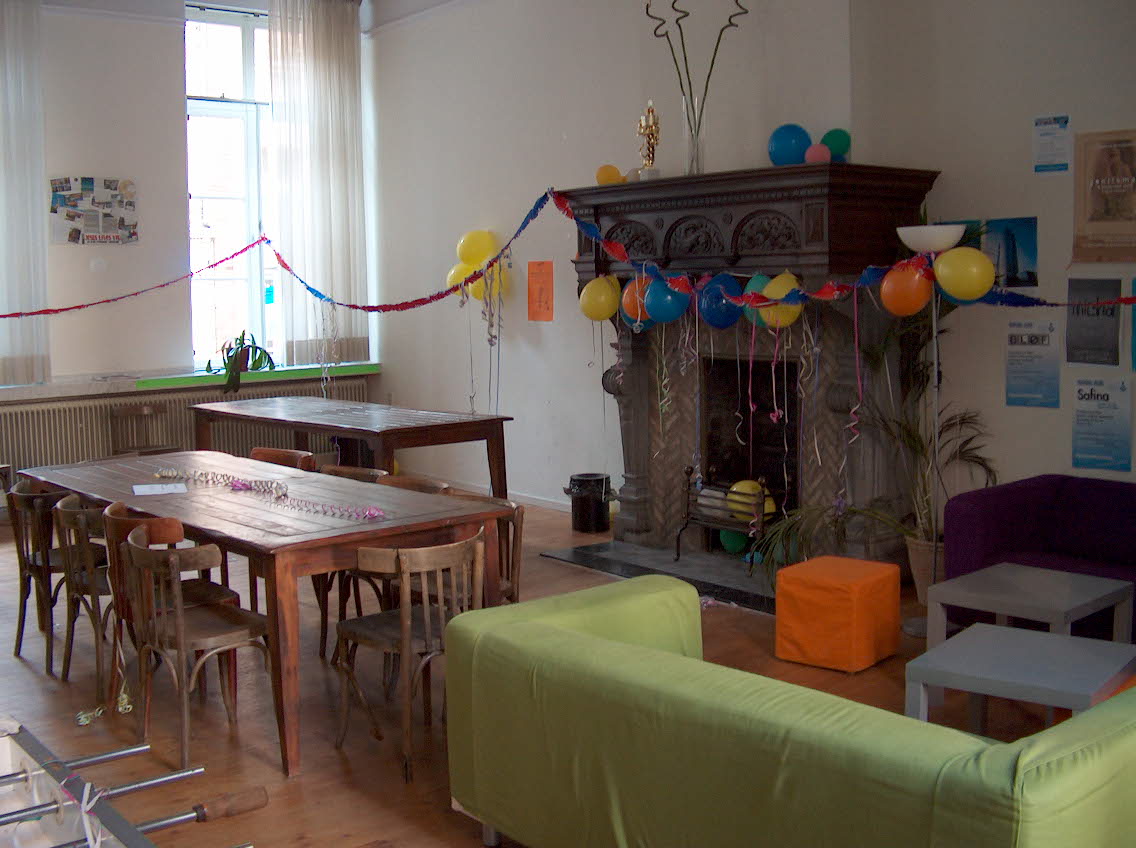
The common room has always been a central space for students to gather and relax. Back when we were still located at the Bouillonstraat, it was literally a living room. It was tiny compared to the building at the Nieuwenhof at Zwingelput, but usually there was enough space for everyone. A cozy room to meet in which was quiet as long as nobody was using the foosball table. And if the room felt too cramped at times, we still had the lovely garden. A comfortable patch of grass to sit on and finish the readings.
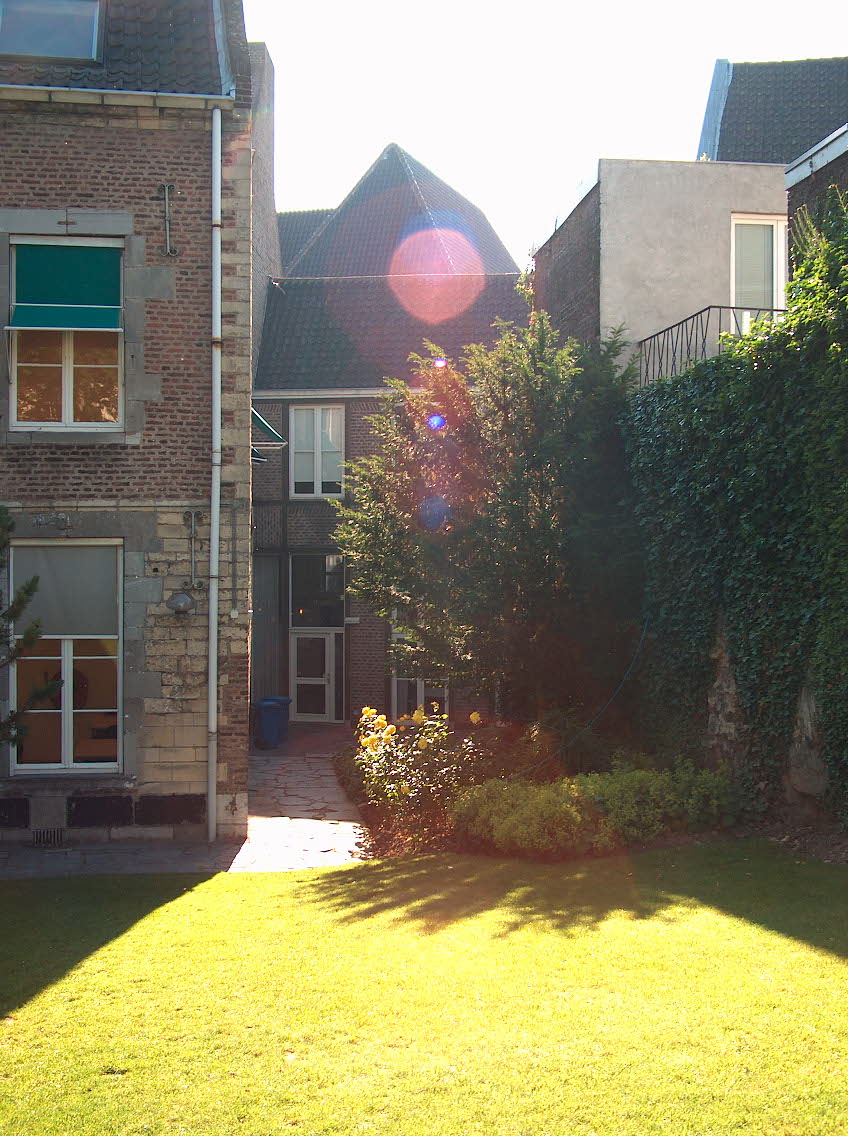
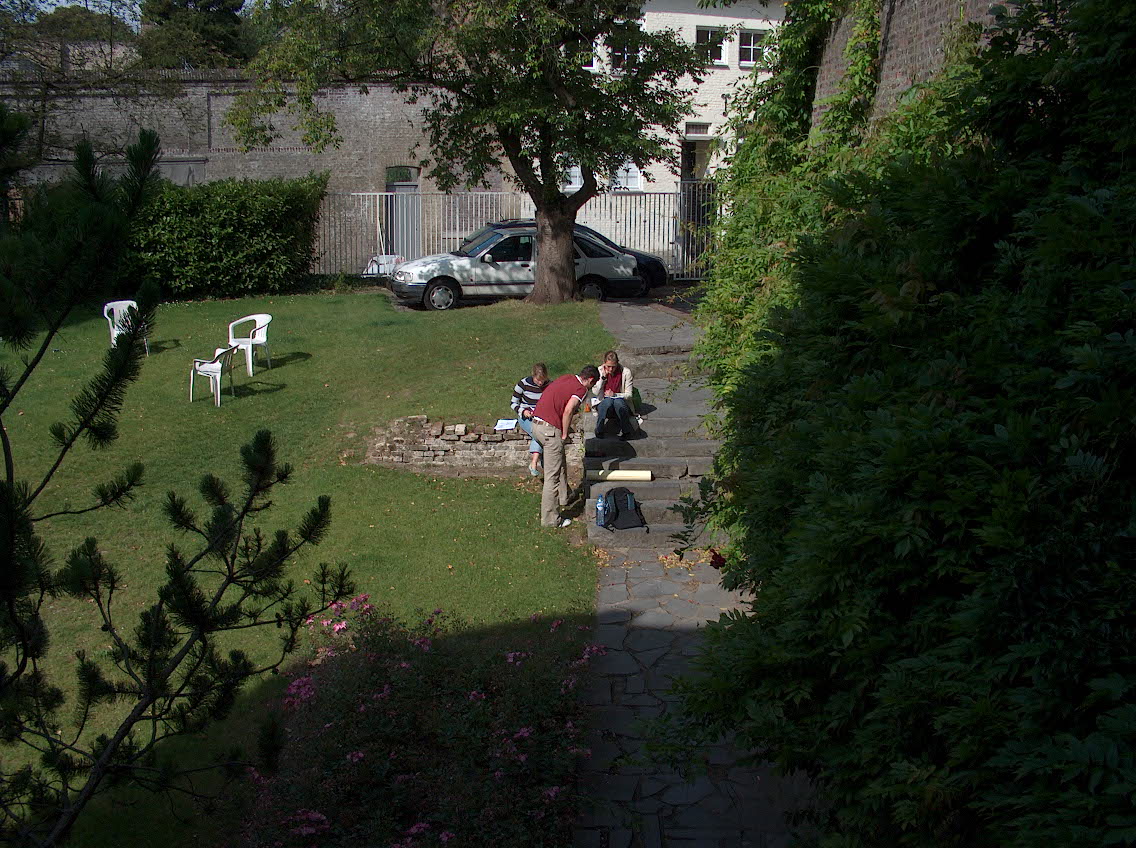
Now at the Nieuwenhof, it is much larger, but it has always retained that homely, cosy, and welcoming vibe. The Nieuwenhof building was actually built in the fifteenth century. It was first built as a Christian monastery with the intentions to help orphans and the poor at the time. You can really see the building’s past in the lecture hall and the exterior. But it’s the common room that I always found special. There, you can find students playing Cards Against Humanity - with a UCM extension pack - to drive off exam stress, sharing banter, reading books, selling waffles for charity, playing chess, playing the piano, skateboarding, or having passionate discussions about education with core staff members. In a way, the college was really a second home for us. There was always space to talk to one another, whether it was small talk or, as Louis would call it, “communicative action”; discussing important contemporary topics and coming up with solutions to the world’s problems. The courtyard hosted theatre plays, barbecues, poetry nights, and, of course, the neon blue Everything will be ok sign. I really miss the special thing we shared there…
4. Fifteen years at UCM
Jamie scans my face, and I can see her contemplating. "You said you started studying in 2002, right? Then you must have graduated around 2005, already twelve years ago? You seem to remember it quite vividly."
"Uhm… no, that’s not really how it went," I mumble self-consciously. "I graduated, but only a month ago. I’m thirty-three now."
"You studied for fifteen years?" Jamie asks in bewilderment.
"Yeah… I’m considering a masters in Environmental Psychology in Portland, but first, I’m taking a gap year. Obtaining 180 ECTS in fifteen years was quite a demanding task, actually. The pressure sometimes just became too much. One time, I took a year off during my studies to practice Vipassana meditation in Nepal.”
A flight attendant interrupts our conversation to serve me my breakfast. Since I’m a raw vegan, I always get my meals first on flights.
"I went on my first semester abroad to Adelaide in 2010, and on my second semester abroad in Pyongyang in 2015. But enough about me, are you from Australia?"
"Yeah, definitely," Jamie says. She throws a glance at my breakfast, which I’m sure she is envious of. "I’m ‘Strayan as it gets. Born and raised in Darwin. So what did you study at this you-see-am?"
"Oh well, I started out in 2002 you see, when they only had two courses available. So you didn’t really have a choice, as they were still building the program. Since the dean who founded UCM, Louis Boon, also founded the Faculty of Psychology, basically everyone was studying psychology in the beginning. Generally, there weren’t actually more than two options available, so everyone was taking the same two courses at the same time. But after my break in Nepal, I realized psychology wasn’t really for me. I had built such a strong connection with the planet that, upon my return to Maastricht, I joined GECCO - UCM’s sustainability committee - and changed my direction 180 degrees. I then studied anthropology, sociology, and crucial differences for three years. The course catalogue, by then, had turned into a real booklet, and there were now much more courses to choose from. But eventually, I felt like that too wasn’t really my cup of tea. I talked to my academic advisor and she allowed me to take a triple concentration of natural sciences, social sciences, and humanities. When I started taking more courses in cell biology, neuroscience, philosophy, literature, and environmental sciences, I finally felt like a fish in the water. There are currently about 150 courses at UCM, and I must have taken most of them at some point."
"Don’t you miss the friends you made at the beginning of your studies?", Jamie asks.
"I do… most of them graduated within three or four years. I still keep in touch, though. As I said, I met Jamie at the bathrooms after I came back from Nepal. We were by then located at the Nieuwenhof, a new building for our study program, because it had grown so much in size over the course of a few years. We started out with seventy or so students in 2002, but this quickly grew to an intake of 200 students per year, which meant the program now had 600 students in total and we needed a bigger building. In the beginning, the international student population at UCM was smaller, too. It consisted mostly of Dutch students. Jamie was from Germany. Maastricht attracts quite a lot of German students, since it is so close to the border with Germany. We also have a student association at UCM called Universalis, at first there were only a few people running the whole thing. Now, about a third of all students are involved in Universalis, organizing events and committees such as music, poetry, theatre, sports, meditation…"
"Sounds like an interesting place", Jamie says.
"Yeah. You should meet our founding father and first dean, Louis. He’s still enthusiastically working and teaching at UCM and has had a clear view of the way he wanted things from the beginning. You know, he founded UCM mostly because he was bored and looking for a new project to work on. I once walked into his office to have a chat with him about this, because I was quite curious. He was interested in creating a program where students could take courses from different faculties and different fields of studies, and the executive board of Maastricht University suggested that he looked into founding a University College. The University College Utrecht had already been around since 1998. It had an open curriculum, just like the university colleges in the US. The problem with it, though, was that due to bureaucratic reasons, the students’ diplomas weren’t recognized by other educational institutions. They had trouble finding masters and jobs after the university college. Luckily, once UCM was founded, that was no longer a big problem. UCM was definitely experimental in the beginning, but the alumni always got on their feet afterward. You know, we tend to believe that everything will be OK…"
"Everything will be OK?"
5. Everything will be OK (2008+)
As the enthusiasm and the pioneer spirit faded away after the first few years, a new emotion emerged at UCM among students: stress. Dropout rates reached a new high and the culprit was quickly found. The academic year usually starts in September with eight weeks of education for period 1. During the final week, we usually attended a last tutorial for the two courses and the skills course. A couple of days later, we had to submit our final paper or go to an exam. If we were lucky, we could use the weekend to relax, but usually, overly motivated course coordinators had already sent out a few pages to read in preparation for the next course due to start on Monday. The same scheme was repeated more less until period 6 ended at the beginning of July. Sure, we had two weeks off for Christmas and a whole week off for carnival, but in the grand scheme of things, we were working almost the whole year except for July and August.The way UCM worked back then not only put strains on students, but on staff members as well. Imagine that you are still correcting papers while you are already supposed to coordinate the next course.
In 2008 a new dean arrived at UCM: Harm Hospers. He was usually to be found somewhere at UCM and fellow students described him as very approachable. After Louis departure, Harm was the new face of UCM and was the longest serving dean at almost seven years. He once mentioned that his contract as dean never specified an end and joked that he expected to serve as UCM’s dean until he would eventually drop dead from his chair; only to be buried shortly after in the courtyard with a nice plaque.
He was not only concerned about the well-being of the students and staff, but was also faced with another issue: money. UCM had to raise tuition fees and lower its budget if it should be economically viable in the future. Harm managed to find an ingenious solution to solve all these problems on one swoop: reflection weeks and exam weeks.
By reducing eight weeks of lectures and tutorials per period to only six weeks, he greatly reduced the costs for staff. Week seven was used as exam week to give students more time to prepare in an effort to reduce stress, while week eight was established as reflection week. A whole week designated to be spent by students as they pleased. Reflecting over the past weeks and life choices.This change greatly appreciated by staff members, because they had more time to correct exams and prepare the upcoming courses. Students finally had some time to catch their breath in-between periods. Reflection weeks were not only celebrated by UCM’s community, but they also had an influence on the dropout rate, which considerably shrank in the coming years.
When you enter the courtyard today - especially during the evening - one of the most striking things is the blue neon sign, which reads everything will be ok. This credo is ubiquitous among UCM students. I dare say that everyone has heard about and almost anyone has used it at one time or another. In times of stress, exam weeks, course selection time or choice of master programmes, you can hear it in the hallways at UCM. It often serves as a reminder that no matter how stressful life at university or in general might be right now, somehow everything will be ok eventually.
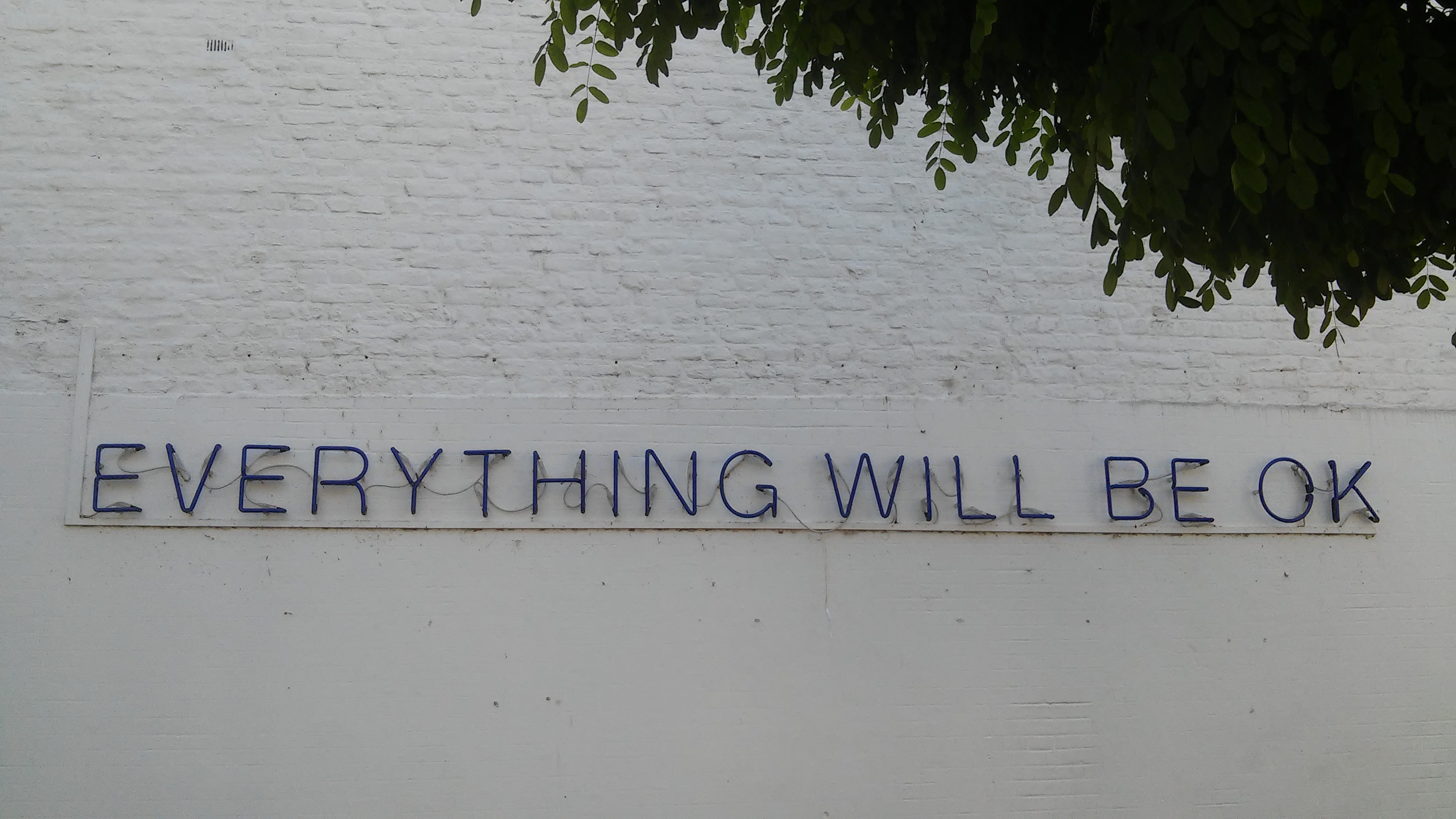
The story behind the blue neon sign is slowly fading from our collective memory as students familiar with it and with Harm Hospers are graduating. While the name Harm Hospers might ring a bell for the current freshmen, they usually think about their friendly and helpful tutor for research methods in their first year and not about the second dean of UCM. Yet, in his years as dean he pledged to spend at least an hour per day in the commonroom or courtyard to get in touch with students. For his office, he used an open-door policy and therefore he was aware of many worries students might be facing at UCM. While talking to them, he noticed that many were mentioning the graffiti at the opposite wall of UCM’s front door. And indeed, when he looked out of his windows he noticed something new he hadn’t paid attention to yet. In bold, black letters it read everything will be ok.
This short sentence seemed to resonate with students and so he went outside to take a quick picture of the wall. The graffiti was eventually removed, but at least it lived on on Harm’s hard drive. Later that year a package arrived at his office and with childlike joy he proceeded to open it. Neatly arranged, he found the thousand postcards he ordered earlier.
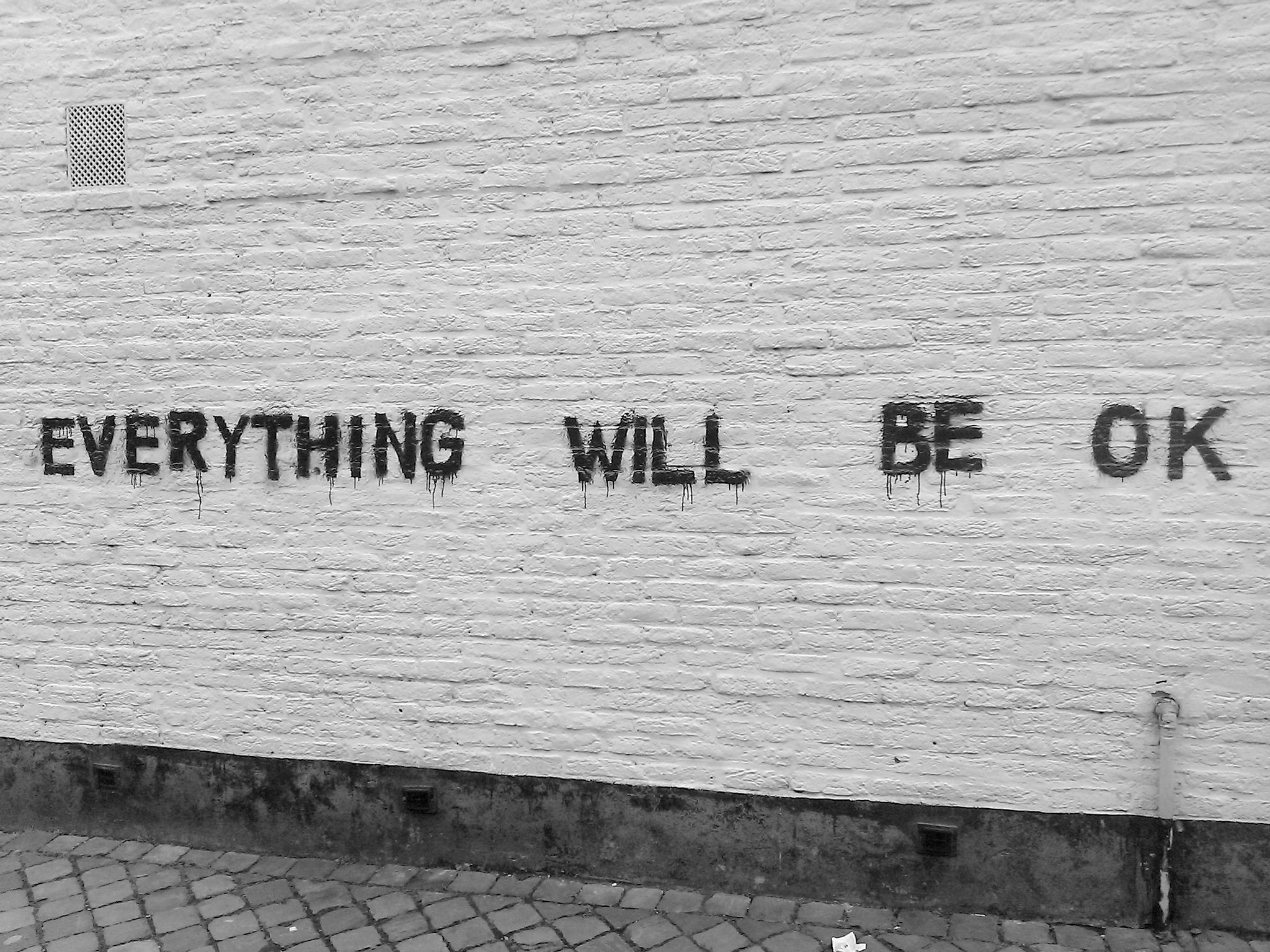
The picture he took decorates the postcards, which Harm would hand out to students in need of advice or motivation. During his tenure as dean he distributed every card but one, which remains in his office.
Even though the graffiti was long gone, the idea of UCM’s unoffic ial motto, everything will be ok, lived on. First on postcards, and nowadays as Harm’s farewell present in blue neon letters. Visible to everyone, who finds their way into the UCM courtyard. UCM alumni treasure these rare cards and from time to time Harm receives selfies with alumni proudly presenting their postcards on top of mountains all over the world.
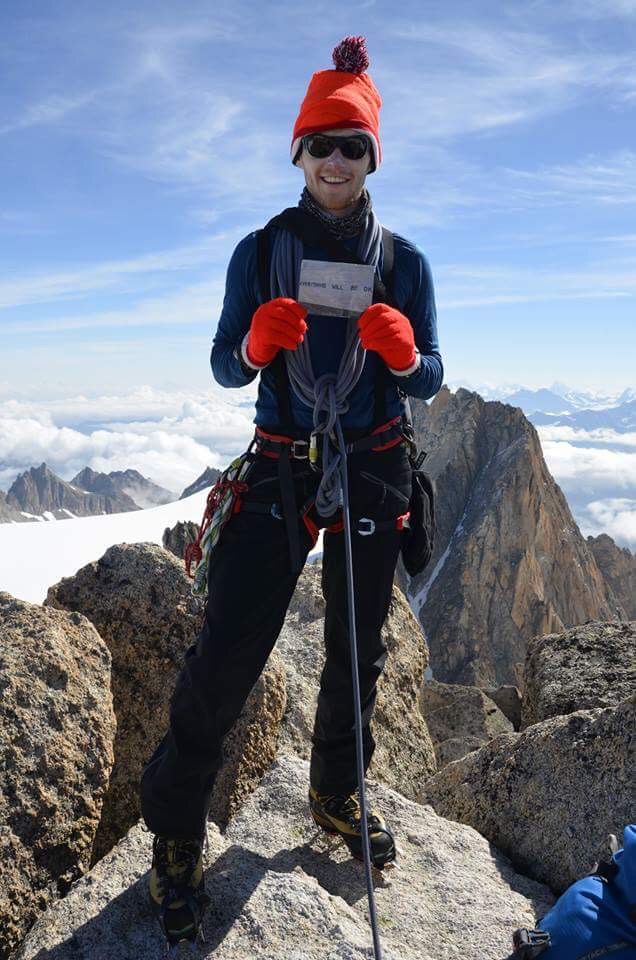
With the fond memories of fifteen years at UCM on my mind, I doze off to sleep on my far too upright aeroplane seat. One of the most meaningful parts of my life has just ended, and a new one is about to begin. I don’t know what life has in store for me or what is waiting on the other side of the world, but I know one thing; everything will be OK. And I can’t help but smile a little.
Everything Will Be OK from Wilfred van Dellen on Vimeo.